Top 5 microcontroller development boards for IoT projects

There are different types of development boards that you can use to build projects involving IoT, such as Single-Board Computers (SBCs) and microcontroller boards. This post showcases a list of top five microcontroller development boards that we recommend for your next IoT project.
1. ESP8266 NodeMCU
The ESP8266 is a widely popular module due its small size and exteremly low price. Although there are
several ESP8266 based boards by different manufacturers, none of them is as widely used as the NodeMCU.
The ESP8266 module provides you with the necessary features for your simple IoT projects. It surely has
a WiFi transceiver for internet connectivity. It also has 17 GPIO pins that include
analog inputs, PWM outputs, and comunication interfaces like UART, SPI and I2C.
2. Adafruit HUZZAH32
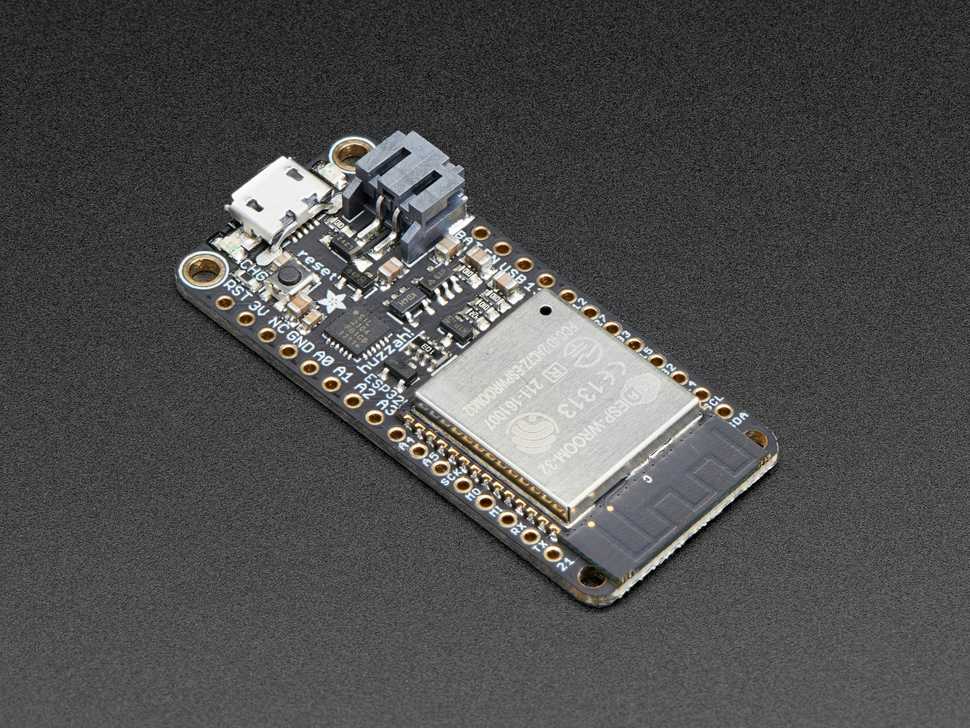
This ESP32 based board is part of Adafruit's Feather boards eco-system. It includes a LiPo battery connector, a built-in USB-to-Serial converter and an automatic bootloader reset. The ESP32 is a step up from the ESP8266, it has more GPIOs, communication peripherals, analog inputs, and two analog outputs. It supports both Bluetooth Classic/LE modes, and alongside WiFi connectivity this board is perfect for IoT applications.
- Microcontroller ICESP32 (Tensilica LX6), 32-bit
- Frequency240MHz
- Flash4MB
- EEPROM-
- Digital I/O13 x pins
3. Arduino Nano 33 IoT
The Arduino Nano 33 IoT is a cheap and powerful board for IoT applications.
The board's low power architecture provided by the Arm-Cortex-M0 SAMD21 microcontroller
makes it a cost effective solution for IoT projects, specially for beginners.
The onboard NINA-W10 module from u-blox allows for WiFi and Bluetooth connectivity in a small package.
The board includes an integrated ECC608A crypto chip to ensure a high level of security.
It also benefits from the Arduino IoT Cloud which simplifies connecting to a WiFi network with secure communication.
- Microcontroller ICATSAMD21G18 ARM Cortex-M0, 32-bit
- Frequency48MHz
- Flash256KB
- EEPROM-
- Digital I/O14 x pins
4. Particle Photon
Based on an STM32 ARM Cortex-M3 microcontroller, the Particle Photon board is a fully integrated IoT
solution with 1MB of flash memory and 128KB of RAM. The board, with its small size,
includes the powerful Broadcom BCM43362 WiFi chip, making it an ideal option for IoT projects.
Particle's cloud-based IDE makes it easier to access the board over the web.
This allows you to program and debug the Photon remotely from anywhere which eases the development process of your
IoT projects.
- Microcontroller ICSTM32F205RGY6 ARM Cortex-M3, 32-bit
- Frequency120MHz
- Flash1MB
- EEPROM16KB (bank 1) + 64KB (bank 2)
- Digital I/O18 x pins
5. Arduino Uno WiFi Rev2
The popular Arduino Uno now can connect to the internet wirelessly without an extra shield or a WiFi module. The new Arduino Uno WiFi board is powered by the ATmega4809 microcontroller. And just like the Nano 33 IoT, the board provides a secure WiFi connection using the ECC608 crypto chip accelerator.
- Microcontroller ICATmega4809, 8-bit
- Frequency16MHz
- Flash48KB
- EEPROM256 Bytes
- Digital I/O14 x pins